Why your business website needs a redesign in 2027
AI answers, fewer clicks and buyers who research on their own have changed what a business website has to do. Here is the case for a redesign, with the data.


In 2027 most buyers meet your company first in an AI answer or a search result they never click, then visit your website to check the details. A redesign makes your site the clear, current source those answers quote and those buyers trust: fast on phones, easy to understand, accessible and safe. Sites built before AI search usually miss at least one of these.
- Google's AI Overviews reach over 2 billion people a month, and 68% of US Google searches now end without a click.
- Buyers research alone first, often with AI, and then verify what they found on your website.
- Half of websites still fail Google's speed and stability checks on mobile.
- Outdated sites carry real risk: accessibility lawsuits and unpatched plugins keep rising.
- A 2027 redesign is less about a new look and more about clarity, proof, speed and being easy for AI to read.
Why does a business website need a redesign in 2027?
Because the way buyers find and judge companies has changed faster than most websites. Search now answers questions on the results page, AI assistants summarize vendors before anyone visits, and buyers prefer to do their research alone. A site built for the old pattern, where people clicked a blue link and read your homepage top to bottom, misses most of these moments.
A redesign in 2027 is less about a fresh look and more about four jobs: be the clear source AI answers quote, convince the buyer who arrives to verify, work fast on any phone, and stay safe and accessible.
How has AI changed the way buyers find your business?
AI answers now sit on top of search. Google says its AI Overviews reach more than 2 billion people a month, and its conversational AI Mode passed 1 billion monthly users in 2026. Assistants like ChatGPT are used for the same research.
The result is fewer clicks. In the first four months of 2026, 68% of US Google searches ended without a click, up from 60% in 2024. A randomized study found that when an AI Overview appears, organic clicks drop by 38%.
This does not make your website less important. It changes its role: your pages are now the raw material AI answers are built from. Pages that state clearly what you do, for whom, and with what results are the ones that get summarized and cited. More on this in what AEO is.
Why does every visit matter more now?
When fewer searches send a click, the people who do arrive are further along. They have read a summary, they have a shortlist, and they came to check something specific.
B2B buyers in particular research on their own first. In a January 2026 survey of 1,862 technology buyers, 63% used AI during their purchase, and 94% of those fact-check what AI tells them at least some of the time. Gartner found that 67% of B2B buyers prefer a buying experience without a sales rep, and 69% notice inconsistencies between a company's website and what its sellers say.
So your website has to answer the buyer's questions without a call: what you do, how it works, what it costs or how pricing works, what results you have delivered and how to start.
What do buyers expect when they land on your site?
- A clear first screen. What you do, for whom, and the next step, in plain words.
- Proof. Case studies with specific results, client names you can share, and the people behind the work.
- Answers to the questions they ask sales. Process, timelines, how pricing works, support after launch.
- A site that works on their phone. Fast, readable and easy to tap.
- Current information. Dates, recent work and up-to-date contact details signal a company that is active.
What risks does an outdated website carry?
Old sites do not just look dated. They often carry measurable risks:
| Risk | What the data shows | What a redesign fixes |
|---|---|---|
| Slow pages | Google's [Core Web Vitals](https://developers.google.com/search/docs/appearance/core-web-vitals) set the bar for speed and stability; in 2025 only [48% of websites passed them on mobile](https://almanac.httparchive.org/en/2025/performance) | Modern build, optimized images, lighter pages |
| Accessibility | [95.9% of the top million homepages](https://beaccessible.com/post/web-accessibility-statistics/) have detectable accessibility errors, and [US federal website accessibility lawsuits reached 3,117 in 2025](https://clym.io/blog/ada-web-accessibility-lawsuits-in-the-usa), up 27% | Contrast, alt text, keyboard navigation and forms built to WCAG |
| Security | [11,334 new vulnerabilities](https://patchstack.com/?p=25568) were found in the WordPress ecosystem in 2025, 91% of them in plugins | Fewer plugins, maintained code, a clear update plan |
| Invisible to AI | Content locked in images, PDFs or scripts is hard to read and quote | Text-first, structured pages that load as plain HTML |
How often should a business redesign its website?
There is no fixed rule, but there are benchmarks. Orbit Media found that leading marketing websites redesign about every two years, and Huemor measured 2 years and 4 months for top Inc. 5000 companies.
For most businesses, every 3–5 years is a reasonable cycle. Redesign sooner when:
- your services, market or positioning have changed;
- the site fails on mobile, speed or accessibility;
- your team cannot update it without a developer;
- leads from the website have dropped while your business has not.
Not every problem needs a full redesign. Our guide to redesign vs refresh vs rebuild helps you choose.
Get a free website audit: speed, SEO, AEO and mobile, with the fixes that matter most.
What should a 2027 redesign include?
- Answer-first content. Each key page answers one real buyer question in the first lines.
- Proof on every page. Case studies, results and names, linked from service pages.
- Mobile-first design. Designed for the phone, then the desktop.
- Speed and accessibility checks before launch. Not as an afterthought.
- SEO that carries over. Redirects, titles and descriptions planned before the build.
- Structure AI can read. Clear headings, tables, FAQs and structured data, on pages that load as text.
- An editor your team can use. So the site stays current after launch.
Our website redesign checklist turns this into steps.
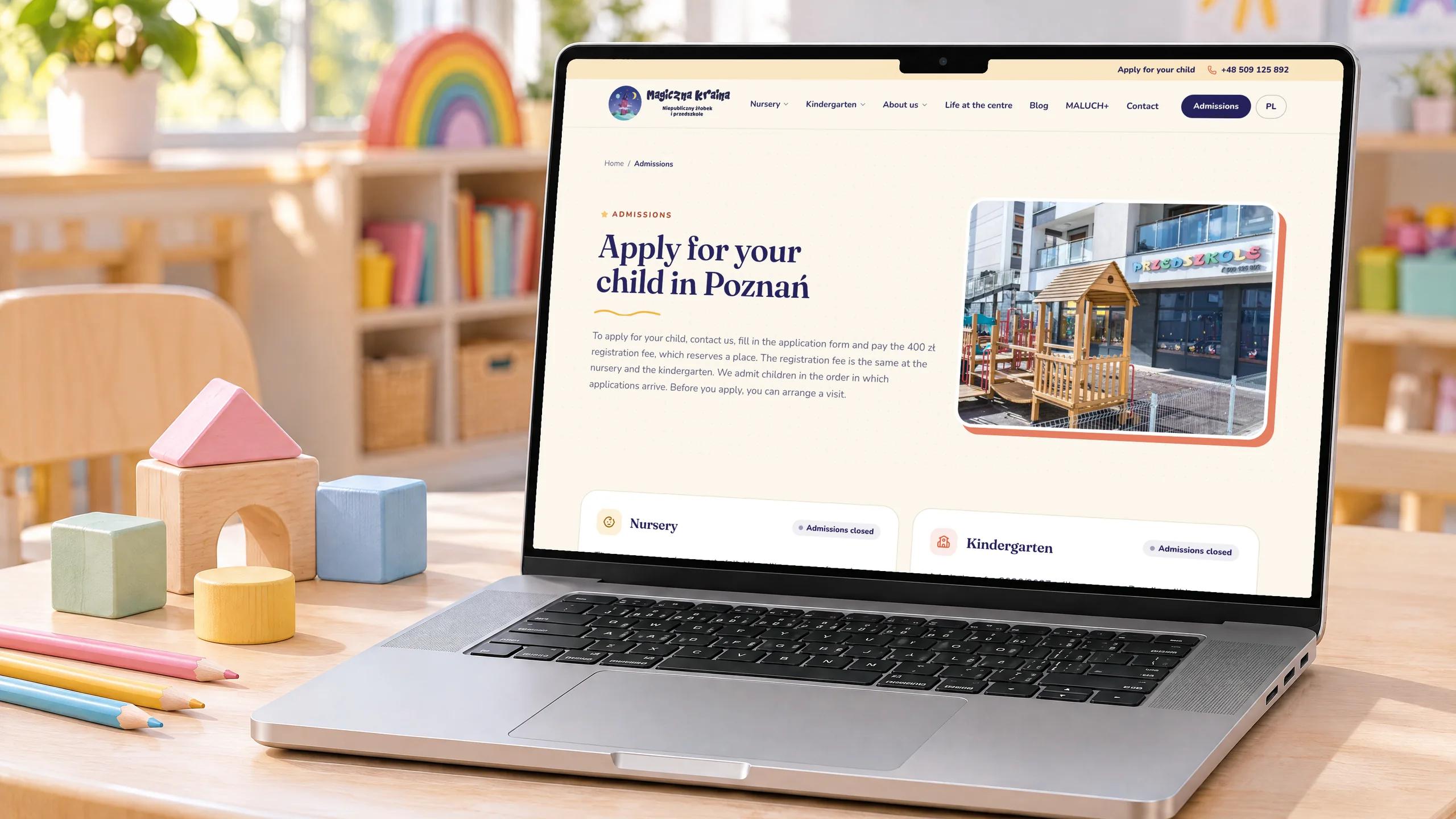 Case study · EducationMagiczna Kraina – website redesign for a nursery and kindergarten100 PageSpeed score on mobile and desktop3 weeks From the first plan to launch0 WCAG A/AA accessibility violations on 12 key pagesRead the case study
How do you know if your website needs a redesign?
Start with three checks: test your homepage on a phone, run it through Google's PageSpeed Insights, and ask an AI assistant what your company does. If the answers are slow, unclear or wrong, your website is costing you buyers you never hear from.
Questions people ask
How often should a business redesign its website?
Leading brands redesign about every two years. For most businesses, every 3–5 years is reasonable, sooner if your offer, market or platform has changed or the site fails on speed, mobile or accessibility.
Is a redesign worth it if the site still works?
Working is not the same as winning work. If buyers cannot quickly see what you do, see proof and take the next step on a phone, a redesign usually pays back through more and better leads.
Will a redesign hurt my Google rankings?
Not if the old addresses are redirected and the pages that rank keep their content and titles. Plan the SEO migration before you start.
Do I need a full redesign to show up in AI answers?
Not always. Clear, answer-first content and a fast, crawlable site matter most. If your current platform makes that hard, a redesign is the faster route.
Sources
- Google says AI Overviews has hit 2 billion users (Nairametrics, Mar 2026)
- Google shares first AI Mode usage data (Search Engine Journal)
- In 2026, less than one third of Google searches still send a click (SparkToro)
- AI Overviews cut organic clicks 38%, field study finds (Search Engine Journal)
- TrustRadius 2026 B2B buying report, 1,862 buyers (MarketScale)
- Gartner: 67% of B2B buyers favor a rep-free experience (Digital Commerce 360, Mar 2026)
- Gartner: 61% of B2B buyers prefer a rep-free buying experience (Jun 2025)
- Core Web Vitals (Google Search Central)
- Performance chapter, Web Almanac 2025 (HTTP Archive)
- The 2026 web accessibility statistics report (WebAIM Million figures)
- ADA web accessibility lawsuits in the USA (Seyfarth Shaw figures)
- Patchstack: state of WordPress security, 2025 figures
- What is the average website lifespan? (Orbit Media)
- How often should you redesign a website? (Huemor)
For 10 years Vlad has led the design and build of websites, apps and internal tools for companies across industries. He writes about what keeps software projects on time and how businesses get found in search and AI answers.
More about us