What is AEO? Answer engine optimization for business websites
Answer engine optimization explained in plain English: how it differs from SEO and GEO, what Google says about it and the changes that help AI assistants find and quote your website.

AEO (answer engine optimization) means making your website easy for AI-powered answers to find, understand and quote: Google's AI Overviews and AI Mode, ChatGPT, Perplexity, Copilot and voice assistants. In practice it is good SEO plus pages that answer real questions directly, in clear structure, on a fast site that crawlers can read. There is no separate trick: Google says its AI features use the same index and ranking systems as regular search.
- AEO aims to get your business quoted or cited in AI answers, not just ranked in a list of links.
- SEO, AEO and GEO overlap heavily; Google calls optimizing for AI search "still SEO".
- Answer-first content, clear structure and fresh, expert pages do most of the work.
- Special files like llms.txt and "AI-only" markup are not needed for Google.
- Measure AEO with AI referral traffic, brand mentions in answers and leads, not only rankings.
What is AEO?
AEO, or answer engine optimization, is the work of making your website easy for AI-powered answers to find, understand and quote. "Answer engines" are the tools that reply with an answer instead of a list of links: Google's AI Overviews and AI Mode, ChatGPT, Perplexity, Microsoft Copilot and voice assistants.
With classic SEO, success means ranking high in the list of results. With AEO, success means your business, your facts or your page appear inside the answer, ideally with a link.
Why does AEO matter for a business website?
Because a growing share of research now ends inside an answer. In early 2026, 68% of US Google searches ended without a click, and ChatGPT alone reported 900 million weekly users. AI Overviews appear most on informational questions, about 36% of them, which is exactly where buyers start: "how long does a redesign take", "what does a customer portal cost", "who builds apps for manufacturers".
If your pages answer those questions clearly, AI can name you at the moment a buyer forms a shortlist. If they do not, a competitor's page gets quoted instead.
What is the difference between SEO, AEO and GEO?
The three overlap more than the marketing around them suggests.
| SEO | AEO | GEO | |
|---|---|---|---|
| Goal | Rank in the list of search results | Be the direct answer or a cited source in search answers | Be named or cited in chat assistants' answers |
| Where | Google and Bing results pages | AI Overviews, AI Mode, featured snippets, voice | ChatGPT, Perplexity, Copilot, Claude, Gemini |
| Success looks like | Position, clicks | Citations, mentions, clicks from answers | Mentions, citations, referral visits |
| Foundation | Crawlable, relevant, trusted pages | The same, plus answer-first structure | The same, plus clear facts about your business |
Google's own guidance, updated in May 2026, puts it plainly: its AI features use the same index and ranking systems as regular search, and optimizing for them is, in Search Engine Journal's summary, "still SEO". We agree. Think of AEO as SEO done for the way people search now.
How do answer engines choose which pages to quote?
The details differ by tool, but the same signals keep showing up:
- Can they reach the page? The page must be crawlable and indexed. For ChatGPT search, OpenAI's search crawler must be allowed in.
- Does the page answer the question? Direct, specific answers are easier to lift than vague marketing copy.
- Is it easy to extract? Clear headings, short paragraphs, lists and tables.
- Is it current? An Ahrefs study of 17 million citations found that AI assistants tend to cite fresher content.
- Is the source credible? Named authors, real expertise, case studies and a site that others mention.
How do you optimize a website for AEO?
Most of the work is practical and unglamorous:
- List the questions buyers ask. Sales calls, emails and support tickets are the best source.
- Answer each question on the right page, first. One or two sentences that fully answer it, then the detail.
- Use question-style headings. "How long does a redesign take?" works better than "Our timeline".
- Put facts in structure. Tables for comparisons, numbered steps for processes, an FAQ at the end.
- Say clearly who you are. Company name, what you do, who you serve and proof, the same way on your site, Google Business Profile, LinkedIn and directories.
- Show expertise. Author names with real roles, case studies with specific results.
- Keep pages fresh. Update key pages and show an "Updated" date.
- Make the site fast and readable as text. Content that loads as HTML, not inside images, PDFs or heavy scripts.
- Let AI crawlers in. Check that your robots.txt does not block the crawlers of the tools you want to appear in.
Get a free website audit: speed, SEO, AEO and mobile, with the fixes that matter most.
What does Google say you do not need for AEO?
Google's guide includes a section on what you do not need to do. In short:
- No llms.txt or special AI files. Google says search does not use them. We cover this in do you need llms.txt?.
- No "AI-only" structured data. There is no special schema for AI features. Regular structured data still helps rich results.
- No rewriting into tiny chunks. There is no ideal page length; write for people.
- No buying mentions. Inauthentic mentions are not as helpful as they may seem.
The data agrees on schema: when Ahrefs tracked pages that added structured data, AI citations did not meaningfully change. Structured data is a good foundation, not a shortcut.
How do you measure AEO results?
Rankings alone no longer tell the story. Track:
- AI referral traffic in your analytics: visits from chatgpt.com, perplexity.ai, gemini.google.com and copilot.microsoft.com. It is still small for most sites, around 1% of visits, but growing fast.
- Mentions and citations from your monthly prompt checks.
- Branded search in Google Search Console: more people searching your name often follows AI mentions.
- Leads and their source. Add "How did you hear about us?" to your contact form; "ChatGPT" is now a common answer.
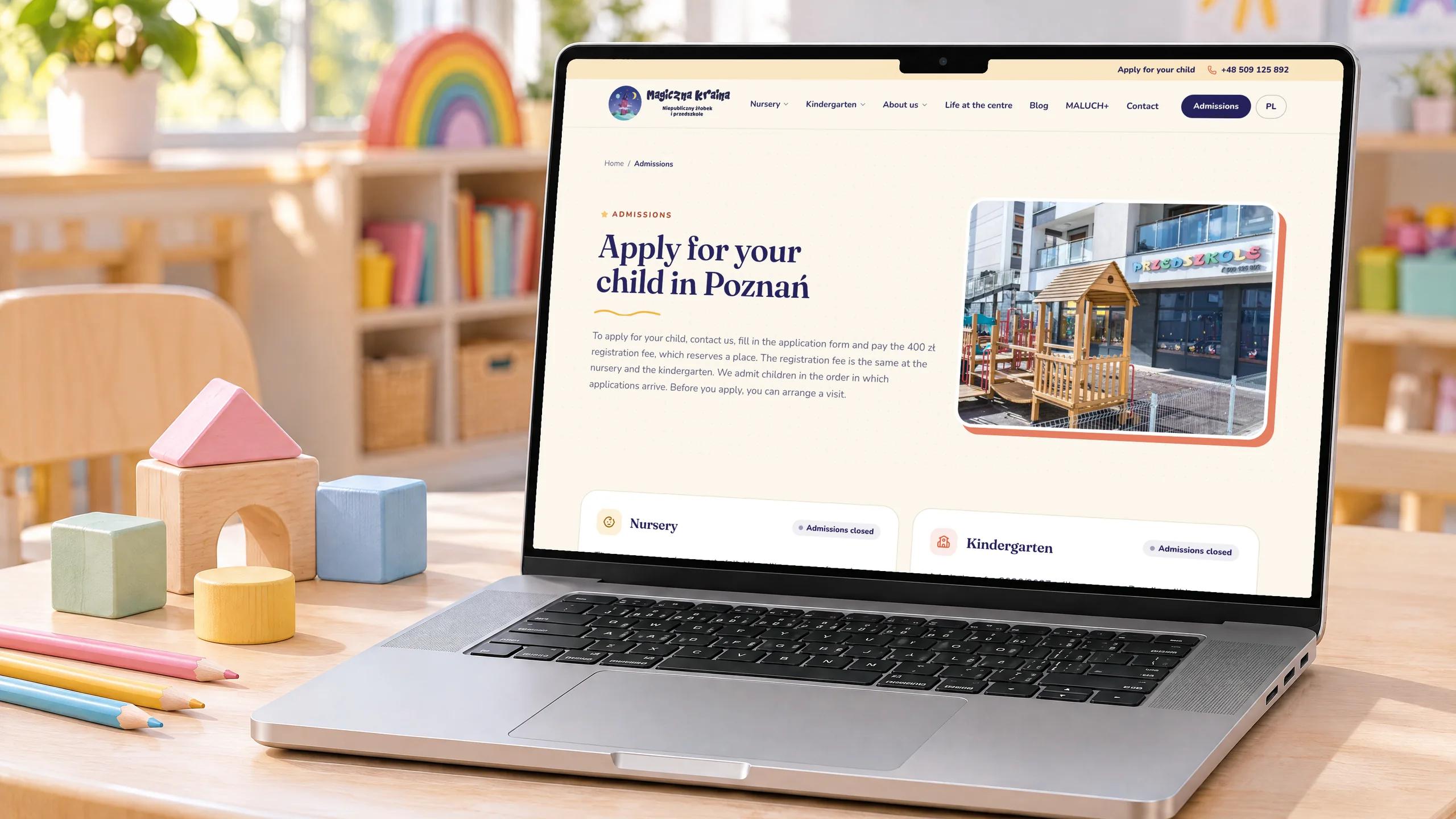 Case study · EducationMagiczna Kraina – website redesign for a nursery and kindergarten100 PageSpeed score on mobile and desktop3 weeks From the first plan to launch0 WCAG A/AA accessibility violations on 12 key pagesRead the case study
Is AEO a reason to redesign your website?
Sometimes. If your site already loads fast, uses clear headings and lets you edit content easily, AEO is mainly a content job. If your content is locked in images or scripts, your pages are slow, or your team cannot update the site, a redesign is the faster route. Read why a website needs a redesign in 2027 for the full picture.
Questions people ask
What does AEO stand for?
Answer engine optimization: improving your website so AI-powered answer engines, like Google's AI Overviews and ChatGPT, can find, understand and quote it.
Is AEO replacing SEO?
No. AI answers draw on the same indexed pages that search does. AEO builds on SEO; a site that is weak in SEO is rarely strong in AI answers.
What is the difference between AEO and GEO?
The terms overlap. AEO is often used for direct answers in search (AI Overviews, featured snippets, voice), GEO (generative engine optimization) for citations inside chat assistants like ChatGPT. The work behind both is largely the same.
How long does AEO take to show results?
Technical fixes and clearer pages can be picked up within weeks of being crawled. Earning regular citations takes longer and depends on your topic, competition and how often you publish.
Do I need structured data for AEO?
It helps search engines understand your pages and earn rich results, but a large Ahrefs study found that adding schema alone did not increase AI citations. Treat it as a foundation, not a shortcut.
Sources
- Optimizing your website for generative AI features on Google Search (Google Search Central)
- Google's new AI search guide calls AEO and GEO still SEO (Search Engine Journal)
- In 2026, less than one third of Google searches still send a click (SparkToro)
- ChatGPT nears 1 billion weekly users (eWeek, 900M in Feb 2026)
- Google AI Overviews and organic CTR in 2026 (ALM Corp, Seer data)
- AI assistants prefer to cite fresher content (Ahrefs, 17M citations)
- Adding JSON-LD schema did not increase AI citations (TechWyse on Ahrefs study)
- AI traffic grew 16x from 2024 to 2026 (SE Ranking)
- Overview of OpenAI crawlers (OpenAI)
For 10 years Vlad has led the design and build of websites, apps and internal tools for companies across industries. He writes about what keeps software projects on time and how businesses get found in search and AI answers.
More about us