How to get your business cited by ChatGPT and Google AI Overviews
Practical steps that help ChatGPT, Google's AI Overviews and other assistants find, trust and cite your business, and how to check if it is working.

AI assistants cite pages they can crawl, that answer the question directly and that come from a source they trust. To get cited, let their crawlers into your site, be indexed in Google and Bing, publish clear answers to the questions your buyers ask, keep those pages fresh, and make sure other credible sites describe your business the same way you do. Then check monthly which pages they quote.
- Google's AI Overviews draw on Google's index; ChatGPT search relies on its own crawler and search partners.
- A page that is blocked, slow or locked in scripts cannot be cited, however good it is.
- Direct, specific answers to real buyer questions get quoted; vague marketing copy does not.
- Fresh, dated pages and consistent business details across the web build trust.
- Track AI referrals and run monthly prompt checks to see what is working.
How do ChatGPT and Google AI Overviews choose which businesses to cite?
They look for pages that answer the question, that they can reach and read, and that come from a credible source. Google says its AI Overviews and AI Mode use the same index and ranking systems as regular search. ChatGPT's search answers rely on OpenAI's own search crawler and search partners. Either way, your page has to be found, understood and trusted before it can be quoted.
The audience is large: Google's AI Overviews reach over 2 billion people a month and ChatGPT reported 900 million weekly users in early 2026. Among B2B technology buyers, 63% used AI during their last purchase.
Step 1: Can AI crawlers reach your website?
Start with access, because nothing else matters if the door is closed.
- Check robots.txt. Make sure it does not block the crawlers you want to appear in. For ChatGPT search, that is OpenAI's OAI-SearchBot; Perplexity uses PerplexityBot; Anthropic's Claude uses ClaudeBot and related agents. Google's AI Overviews use the regular Googlebot.
- Check your firewall or CDN. Some security settings block unknown bots by default, including AI crawlers.
- Make content readable as text. Pages that only show content after heavy scripts run, or put key facts inside images and PDFs, are harder to read and quote.
Step 2: Are you indexed in Google and Bing?
AI answers are built on search indexes. Verify your site in Google Search Console and Bing Webmaster Tools, submit your XML sitemap to both, and fix pages that are excluded from the index. Bing matters more than its search share suggests: Microsoft Copilot runs on it, and other assistants also draw on search partners.
Step 3: Do your pages answer the questions buyers ask?
This is where most business websites fall short. AI assistants quote pages that answer a specific question directly. Marketing copy like "innovative solutions for your digital journey" gives them nothing to quote.
- Collect the real questions from sales calls and emails: "How long does it take?", "Do you work with manufacturers?", "Can it connect to our ERP?".
- Answer each one in the first sentence or two, under a heading that asks the question.
- Add the detail after the answer: steps, a table, an example.
- End key pages with an FAQ of 3–5 questions.
Service pages, case studies and articles all benefit. A case study that states the client, the problem, what you built and the measurable result is far more quotable than one that only shows pictures.
Step 4: Make facts easy to lift
AI tools extract information. Help them:
- Tables for comparisons, specifications and timelines.
- Numbered steps for processes.
- Specific numbers and names: "launched in 3 weeks", "18 pages", "5 countries".
- One topic per page, with a clear title that says what the page is about.
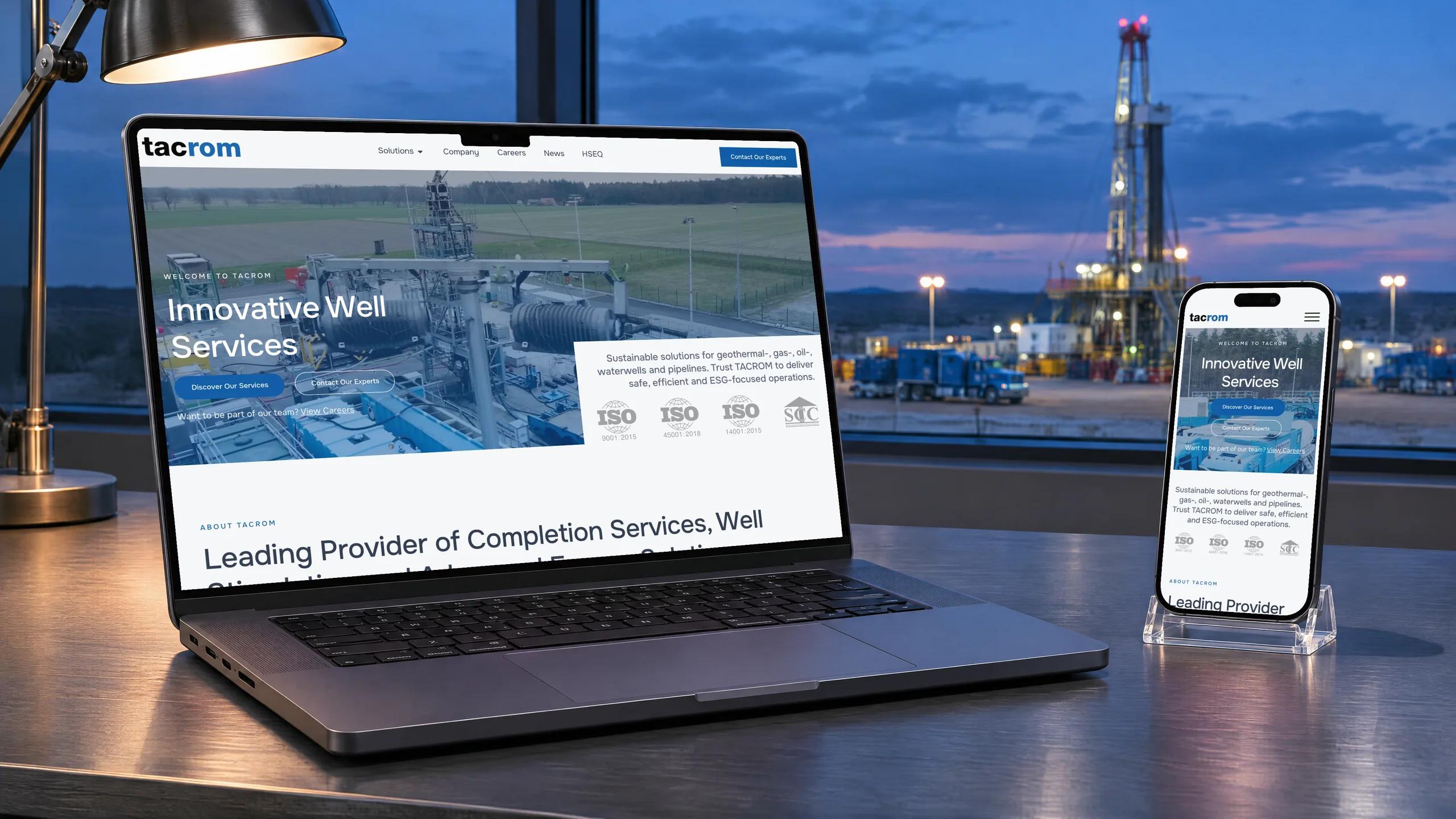 Case study · EnergyTACROM – corporate website for an international well services company18 pages In the new sitemap, plus the news archive4 Service lines, each with its own page5 Countries with regional contacts on one pageRead the case study
Step 5: Keep important pages fresh
An Ahrefs analysis of 17 million citations found that AI assistants tend to cite fresher content, with ChatGPT showing the strongest preference. Review your key pages at least twice a year, update facts and examples, and show an "Updated" date. Publishing new articles regularly also gives crawlers a reason to come back.
Step 6: Be described the same way across the web
Assistants cross-check. When your website, Google Business Profile, LinkedIn page, directories and review sites all say the same thing about who you are and what you do, you are easier to recognize and trust.
- Use the same company name, description and services everywhere.
- Keep contact details consistent.
- Earn real mentions: client reviews, partner pages, industry associations, interviews. Google notes that seeking inauthentic mentions is not as helpful as it may seem.
Get a free website audit: speed, SEO, AEO and mobile, with the fixes that matter most.
Step 7: Show who is behind the content
Name the author, give their role and experience, and link to an about page with the team and your case studies. Expertise you can verify is a stronger signal than anonymous text, for people and for AI.
How do you know if it is working?
- AI referral traffic: in Google Analytics, look for visits from chatgpt.com, perplexity.ai, gemini.google.com and copilot.microsoft.com. For most sites it is around 1% of visits, but it is growing fast.
- Monthly prompt checks: ask the main assistants the questions your buyers ask, and note who gets named and which pages are cited.
- Branded search: rising searches for your company name in Search Console often follow AI mentions.
- Lead source: add "How did you hear about us?" to your contact form.
For the bigger picture, read what AEO is, and for a common myth, whether you need llms.txt.
Questions people ask
Can I pay to be cited by ChatGPT or AI Overviews?
No. Citations in answers are not sold. Ads are appearing around AI answers in some products, but being cited depends on your content and reputation.
Do I need to rank #1 on Google to appear in AI Overviews?
No, but AI Overviews draw on Google's index and ranking systems, so pages that rank well for a topic are more likely to be used.
How long does it take to get cited?
Once a page is crawled and indexed, it can be cited within weeks. Becoming a regular source for a topic takes months of consistent, useful content.
Should I block AI crawlers to protect my content?
If you want to be cited, no. Blocking the search crawlers of ChatGPT, Perplexity or others removes your pages from their answers. You can block training crawlers separately if you prefer.
Sources
- Optimizing your website for generative AI features on Google Search (Google Search Central)
- Overview of OpenAI crawlers (OpenAI)
- AI assistants prefer to cite fresher content (Ahrefs)
- ChatGPT nears 1 billion weekly users (eWeek, 900M in Feb 2026)
- Google says AI Overviews has hit 2 billion users (Nairametrics)
- AI traffic grew 16x from 2024 to 2026 (SE Ranking)
- TrustRadius 2026 B2B buying report, 1,862 buyers (MarketScale)
For 10 years Vlad has led the design and build of websites, apps and internal tools for companies across industries. He writes about what keeps software projects on time and how businesses get found in search and AI answers.
More about us