How B2B buyers research vendors with AI, and what your website must answer
Most B2B buyers now start vendor research with AI and then verify on your website. Here is what the data shows, and the questions your site has to answer to make the shortlist.

B2B buyers increasingly start vendor research with AI assistants, build a shortlist on their own and contact sales late. In a 2026 survey, 63% of technology buyers used AI during their purchase, and 94% of them fact-check what AI tells them. Your site therefore has to answer, without a call, what you do, for whom, how you work, what it costs or how pricing works, and what results you have delivered.
- 63% of tech buyers used AI in their last purchase; 94% of them fact-check what it says.
- 67% of B2B buyers prefer to buy without a sales rep, up from 61% a year earlier.
- 69% notice inconsistencies between a vendor's website and what its sellers say.
- AI assistants summarize vendors from what is published; vague websites get vague summaries.
- A website that answers buyers' real questions works for both the AI summary and the human check.
How do B2B buyers use AI to research vendors?
They use it early, to understand the problem, compare approaches and build a first shortlist, and then they check the vendors themselves. In a January 2026 survey of 1,862 technology buyers by TrustRadius, 63% used AI during their purchase journey, and 54% said it made research easier. A separate January 2026 report found that two thirds of the buyers surveyed use generative AI as much as or more than traditional search.
Forrester describes the same pattern: buyers start with AI, then turn to peers, experts and providers to confirm what it told them.
Do buyers trust what AI tells them about vendors?
Not on its own. 94% of buyers who used AI fact-check its answers at least some of the time. To check, they turn to vendor websites, review sites and people they know.
That makes your website the tie-breaker. If the AI summary says you build customer portals for manufacturers and your site shows exactly that, with a case study, you move forward. If your site is vague or out of date, the buyer moves on, often without contacting you.
Why are buyers contacting sales later?
Because they prefer to. Gartner found that 67% of B2B buyers prefer a buying experience without a sales rep, up from 61% a year earlier. Buyers still want a person for judgment calls, like whether a solution fits their company, but they want to get there with the basics already answered.
Gartner also found that 69% of buyers notice inconsistencies between a vendor's website and what its sellers say. An outdated site does not just lose leads; it undermines your sales team.
What questions must your website answer?
These are the questions buyers ask AI, and then check on your site:
| Buyer question | Where to answer it |
|---|---|
| What exactly do you do, and for whom? | Homepage first screen, service pages |
| Have you done this for a company like ours? | Case studies with industry, problem, solution and results |
| How does a project work, and how long does it take? | A process section with steps and typical timelines |
| What does it cost, or how is it priced? | Pricing models, typical ranges or cost drivers |
| Who will work on our project? | About page, team roles, the people behind the work |
| Can it work with our systems? | Integration notes on service pages and case studies |
| What happens after launch? | Support and ownership terms |
| How do we start? | A clear, low-friction next step on every page |
Get a free website audit: speed, SEO, AEO and mobile, with the fixes that matter most.
How does AI decide what to say about your company?
AI assistants summarize what is published and findable. If your website states clearly what you do, for whom, with which results, the summary will be specific. If your site relies on slogans and images, the summary will be generic, or the assistant will describe a competitor instead.
What helps:
- Specific, quotable statements: "We build customer portals for manufacturers" beats "innovative digital solutions".
- Case studies with facts: client, industry, what you built, measurable results.
- The same description everywhere: your site, LinkedIn, Google Business Profile and directories.
- Fresh content: dated updates and new case studies show you are active.
We explain the technical side in how to get cited by ChatGPT and AI Overviews.
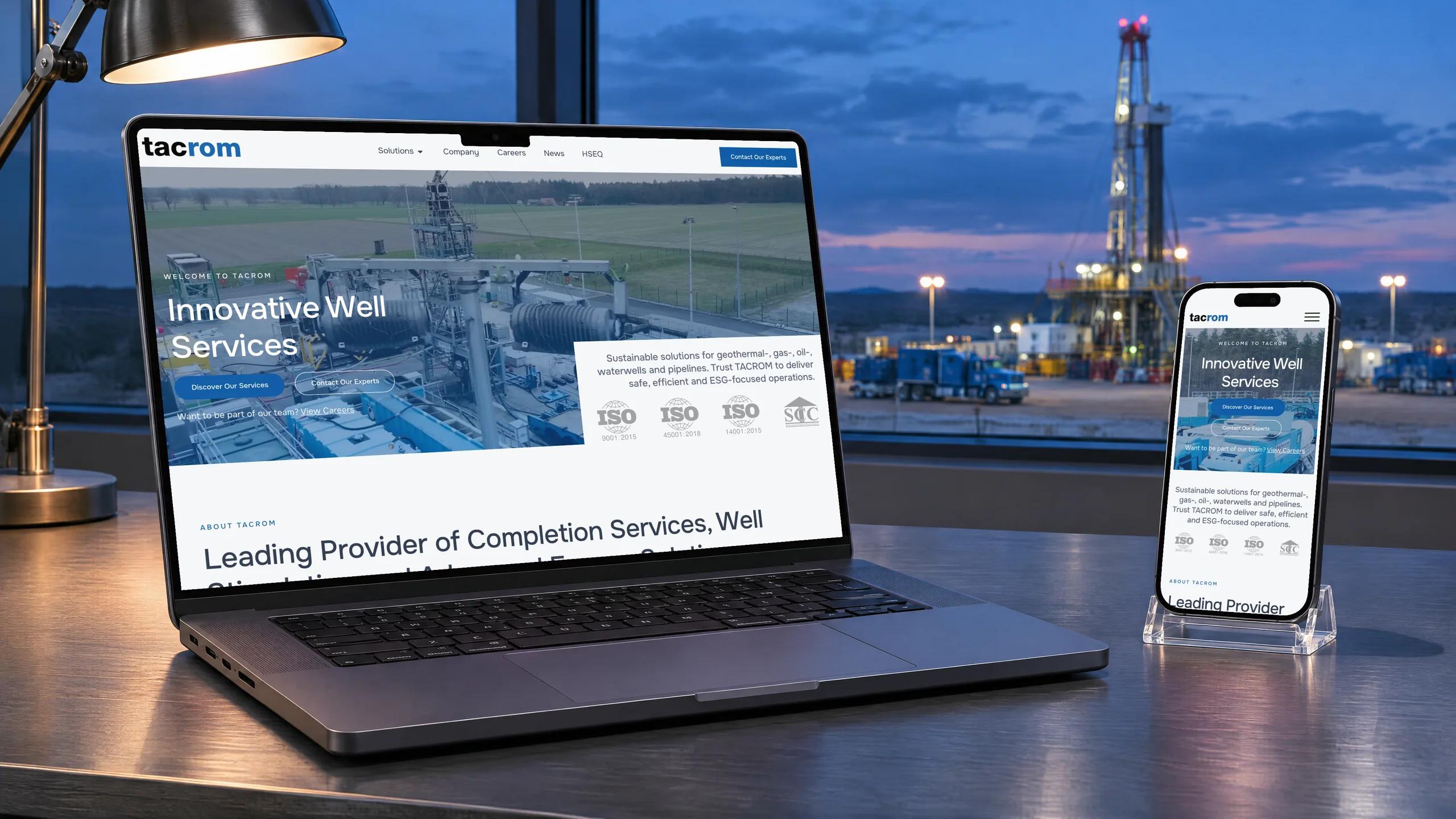 Case study · EnergyTACROM – corporate website for an international well services company18 pages In the new sitemap, plus the news archive4 Service lines, each with its own page5 Countries with regional contacts on one pageRead the case study
What should B2B companies change on their websites first?
- Rewrite the first screen of the homepage and each service page in plain, specific words.
- Upgrade case studies to show the problem, the solution and the result, with numbers you can share.
- Add a process and timeline section so buyers can picture working with you.
- Explain pricing, at least the models and what drives the cost.
- Add FAQs built from real sales questions.
- Check consistency between your website and what your sales team says and sends.
If your current site cannot support this, because it is hard to edit, slow or built around an old structure, that is the strongest sign it is time for a redesign. See why your website needs a redesign in 2027 and, for larger organizations, our corporate website redesign strategy.
Questions people ask
Do B2B buyers really use ChatGPT to choose vendors?
Many use it to start: to understand options, compare approaches and build a first shortlist. Most then verify on vendor websites, review sites and with peers before they decide.
Should we publish our prices on our website?
If you can, show at least how pricing works: models, typical ranges or what drives the cost. Buyers who prefer to research alone will otherwise fill the gap with a competitor's numbers or an AI guess.
What content helps most with AI-assisted buyers?
Specific case studies with results, clear service pages, a description of your process and timelines, and an FAQ that answers the questions your sales team hears every week.
How do we know what AI says about our company?
Ask the main assistants directly, monthly: what does your company do, who do they recommend for your service and industry. Note what is wrong or missing, then fix it on your site.
Sources
- 94% of B2B buyers fact-check AI research outputs (MarketScale)
- Gartner: 67% of B2B buyers favor a rep-free experience (Digital Commerce 360, Mar 2026)
- Gartner: 61% of B2B buyers prefer a rep-free buying experience (Jun 2025)
- AI reshapes B2B buying and RFPs (Digital Commerce 360, Jan 2026)
- Forrester: B2B buying and AI in 2026 (Digital Commerce 360)
For 10 years Vlad has led the design and build of websites, apps and internal tools for companies across industries. He writes about what keeps software projects on time and how businesses get found in search and AI answers.
More about us